Show Me the Proof
:format(webp):quality(60)///national-gallery-of-australia/media/dd/images/371943_Marabeth_Cohen-Tyler_yfLANmS.jpg)
Assistant Curator KIRA GODOROJA-PRIECKAERTS examines the artistic and technical choices behind Helen Frankenthaler's Reflections series, featured in the exhibition Proofs and Processes: The Kenneth E Tyler Collection.
Tyler Graphics was known as one of the most innovative print workshops of the 20th century. It was opened in 1974 by master printer Kenneth Tyler, who had recently left Gemini Graphic Editions Limited in Los Angeles. Based in the countryside beyond New York City, Tyler and his team of skilled collaborators worked with artists to find innovative solutions to their printmaking needs. This year the National Gallery of Australia will be publishing the long-awaited Tyler Graphics: catalogue raisonné, 1986–2001, providing in-depth scholarly research into the prints made at the workshop’s second and largest location in Mount Kisco, New York. This three-volume undertaking contains technically detailed entries for more than 1000 works by 28 artists. The project was made possible by the comprehensive holdings of the Kenneth E. Tyler Collection, including its exceptional archive. These resources give insight into the hidden journey of artistic and technical decisions behind the final editioned work.
To celebrate the release of the catalogue raisonné, selected works by six of the artists will be displayed in the exhibition Proofs and Processes: The Kenneth E. Tyler Collection. Helen Frankenthaler, Roy Lichtenstein, Joan Mitchell, Robert Motherwell, James Rosenquist and Frank Stella were icons of 20th century American art and important collaborators for Tyler. The exhibition will explore the working methods behind their artworks through associated proofs, written documentation, matrices and photographs—granting greater insight into each artist’s practice. The research potential for the Tyler Graphics catalogue raisonné and archive is illustrated in a case study of Helen Frankenthaler and her Reflections series, published by Tyler Graphics in 1995. Frankenthaler was an intuitive creator who was heavily involved in the production of her prints. While some artists would leave instructions for the workshop, Frankenthaler was present at every stage to oversee the evolution of the edition. She did not turn to printmaking to recreate an image from another medium. Each print was a chance to create something new through material experimentation, and she used the proofing process to continuously rework and refine her images. Frankenthaler stated:
‘In a sense, you never know what I am about until you are near the end result… in a way I think that’s why a lot of workshops have liked working with me because it’s another kind of challenge.’1
:quality(60)///national-gallery-of-australia/media/dd/images/350860_Marabeth_Cohen-Tyler.jpg)
Helen Frankenthaler, assisted by Kenneth Tyler, reworking the image on a lithography stone used in proofs for Reflections XII, 1995, from the Reflections series, Tyler Graphics, Mount Kisco, New York, February 1995. Photo by Marabeth Cohen-Tyler © 1995 Marabeth Cohen-Tyler
Helen Frankenthaler: from paint to stone
Frankenthaler was a leading figure in Abstract Expressionism and played a significant role in the Colour Field movement of the 1950s and 60s. A few years younger than other artists in the New York circle such as Jackson Pollock and Willem de Kooning, she was influenced by their work but pushed the movement into new territory. In the early 1950s, Frankenthaler created the ‘soakstain’ technique that was later adopted by artists Morris Louis and Kenneth Noland. For this technique, she poured thinned oil paint onto large sheets of unprimed canvas laid on the ground of her studio. Inspired by Pollock’s gestural practice, this placement allowed her to control the movement of her fluid paint. By pushing the paint with a brush or lifting a corner of the canvas, she directed the liquid flow without limiting movement—creating controlled accidents dictated by the material but guided by her hand. One mark ‘sired’ the next2, continuing until the work was either finished or pushed too far and eventually abandoned. The thinned oil paint soaked through the fibres of canvas, making the stained marks visible from both sides. The works were a confluence of material, not paint on canvas but paint and canvas fully entwined.
In the 1960s the increased accessibility of materials and techniques altered the American art landscape. Commercially available acrylic paints became more widely available. This had a considerable effect on painters, including Frankenthaler whose adoption of the material caused a shift in vibrancy, opacity and mark making. In printmaking, the American lithography revival was underway. Facilitated by the opening of fine art print workshops including Universal Limited Art Editions (ULAE) in 1957, Long Island, New York, and Tamarind Lithography Workshop in 1960, Los Angeles, California. Frankenthaler was an early participant in the revival, publishing her first print with ULAE in 1961, a lithograph aptly titled First stone. From the beginning she focused on the material of the process: the lithography stone onto which she was drawing. Over the decades Frankenthaler continued her admiration for printmaking, describing herself as ‘romanced’ by the newness of the medium with all its variations3. Her practice moved from planographic into intaglio and relief, and she began working with a wide range of print studios—eventually publishing her first works with Tyler Graphics in 1974.4
Helen Frankenthaler working with tusche on a Mylar sheet, over a proof of Reflections IV, 1995, from the Reflections series, in the artist studio at Tyler Graphics, Mount Kisco, New York, 1994
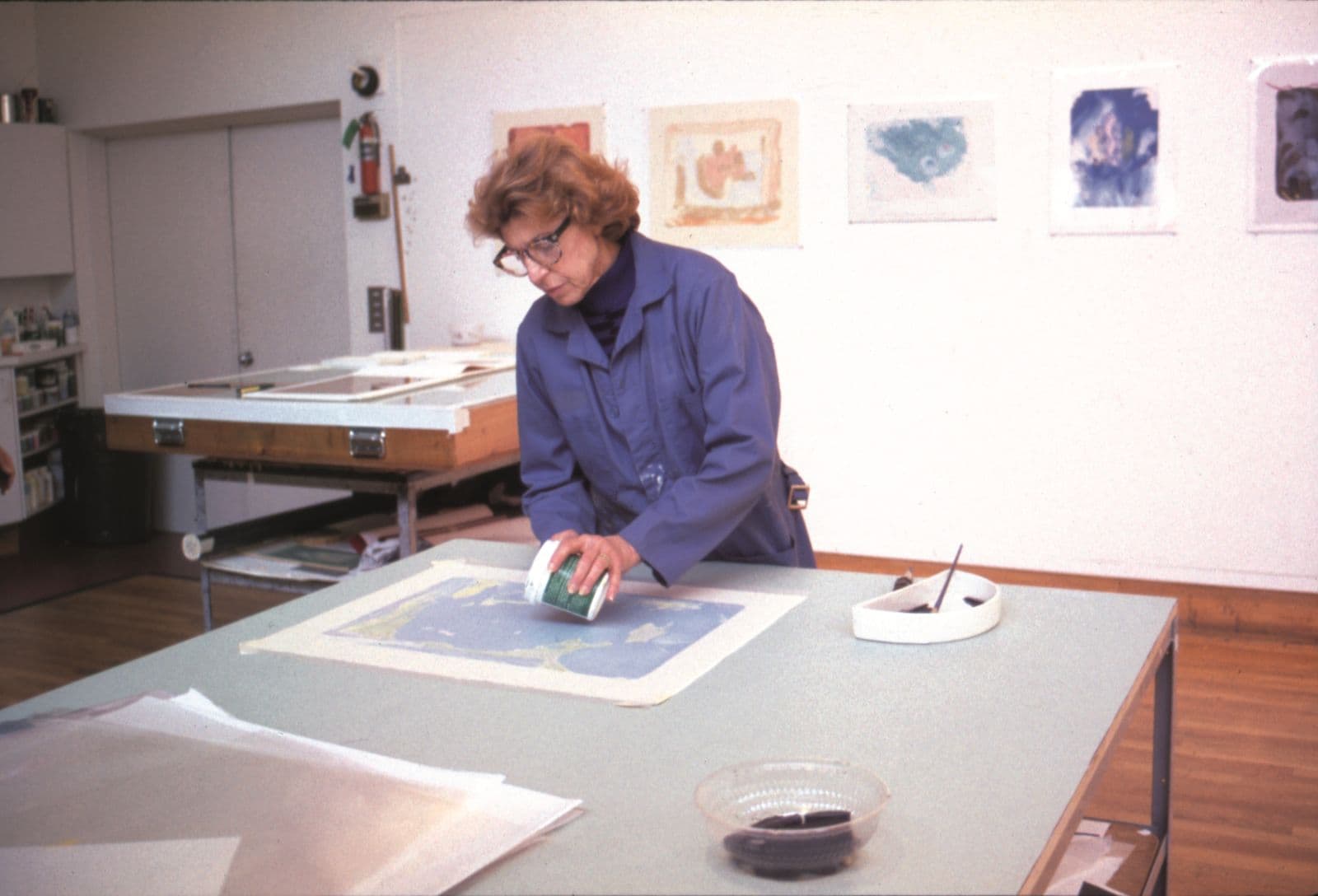
Kenneth E Tyler Collection, National Gallery of Australia, Kamberri/Canberra. Photo by Marabeth Cohen-Tyler © 1995 Marabeth Cohen-Tyler

Kenneth E Tyler Collection, National Gallery of Australia, Kamberri/Canberra. Photo by Marabeth Cohen-Tyler © 1995 Marabeth Cohen-Tyler

Kenneth E Tyler Collection, National Gallery of Australia, Kamberri/Canberra. Photo by Marabeth Cohen-Tyler © 1995 Marabeth Cohen-Tyler

Kenneth E Tyler Collection, National Gallery of Australia, Kamberri/Canberra. Photo by Marabeth Cohen-Tyler © 1995 Marabeth Cohen-Tyler
Technique: building the marks
Despite a long career in printmaking, including outstanding contributions to woodcut printing, Frankenthaler was continuously drawn back to lithography. When publishing the Reflections series in 1995, over three-decades after her first lithograph, Kenneth Tyler wrote: ‘For Frankenthaler, there is nothing like drawing on the smooth receptive surface of prepared limestone. Lithography stones are responsive to every gesture.’5 This series took two years to create and is a celebration of lithography; a tribute to the stone combined with layers of aluminium plate printing. The first layer of each editioned print from the Reflections series features a flat, coloured form printed from an aluminium plate. This form is based on the jagged edges of a well-worn lithography stone that corresponds to the following layer. Next, a drawing on stone is printed (for all but Reflections XII); followed by a series of aluminium plates with complementary marks.
To begin Reflections, Tyler brought 16 stones to Frankenthaler’s studio, which she worked on from June to September of 1993. These were later joined by three larger stones in February 1994. She reworked 11 of the stones, sometimes leaving only traces of her original marks. Using the printed proofs from the stones, she spent the next 11 months creating the subsequent layers for her prints6. For this, she placed a transparent Mylar sheet over a proof and drew corresponding marks with tusche and crayon. Once dried, her drawings were then photographically transferred to aluminium lithography plates. Tyler had developed this Mylar technique to help abstract artists visualise the layered process of printmaking. It allowed Frankenthaler to build her images layer by layer—allowing the marks to direct her practice, as she did in her paintings. However, the benefit of printmaking was that she could trial new layers and alter colours without compromising her existing image. This technique can be seen in the photograph of Frankenthaler’s tusche drawing on a Mylar sheet over a proof of Reflections IV. The mark making she executes is similar to that of the soak-stain. She poured thinned tusche onto the Mylar and directed its spread by blowing it across the page and smudging it with her fingers. The result is a sinuous pool of velvety tusche.
:quality(60)///national-gallery-of-australia/media/dd/images/54980_Frankenthaler_Reflections_XII.png)
Helen Frankenthaler, Tyler Graphics (printed and published), Reflections XII, 1995, from the Reflections series, Kenneth E Tyler Collection, National Gallery of Australia, Kamberri/Canberra, purchased with the assistance of the Orde Poynton Fund 2002. © Helen Frankenthaler / Tyler Graphics Ltd. 1995
Proofing: refining the image
The many proofs for the Reflections series can offer insight into how Frankenthaler arrived at the final composition. The editioned print of Reflections XII is a fourlayer lithograph printed in yellow, magenta, dark magenta and green, from aluminium lithography plates. The proofs show that the work originally featured a drawing on stone. However, in later iterations, the only trace of this drawing is the yellow shape of the stone in the background.
By moving through the selection of trial proofs (TPs) and colour trial proofs (CTPs) for Reflections XII, one can picture the steps that Frankenthaler took to develop the final published image. She begins with first drawing on the stone, printed in TP 2: furied zig-zags, sweeping strokes, delicate curls of crayon and what looks like the stamp of a cylindrical container. Unsatisfied, she had Tyler open the stone again so she could rework the image to create TP 4: a fuller image that spills to the edges of the stone, exposing its broken corner. From here, Frankenthaler begins to create the accompanying layers. In CTPs 2, 4, 6 and 8 she is adding, removing, recolouring and altering the edges for a series of layers printed from aluminium lithography plates. You can track each layer’s entrance and exit from the print, gradually leading to the editioned work.

Helen Frankenthaler, Tyler Graphics (printed and published), Reflections XII, 1995, from the Reflections series, trial proof 2 of 4, Kenneth E Tyler Collection, National Gallery of Australia, Kamberri/Canberra, gift of Kenneth Tyler 2002. © Helen Frankenthaler / Tyler Graphics Ltd. 1995

Helen Frankenthaler, Tyler Graphics (printed and published), Reflections XII, 1995, from the Reflections series, trial proof 4 of 4, Kenneth E Tyler Collection, National Gallery of Australia, Kamberri/Canberra, gift of Kenneth Tyler 2002. © Helen Frankenthaler / Tyler Graphics Ltd. 1995
The final green layer is the first to appear, in CTP 2, as the painted pink line across the top of the page with two smaller perpendicular lines meandering down the page. By the end, the image of this layer will be greatly reduced with each side adjusted until only a sliver remains. Next to appear is the concept of the first layer, the block of flat colour that provides the shape of the lithography stone. In CTP 4, the background colour fills out the stone, uniting the drawing on the drawing with the form it is drawn upon. The spreading tendrils of the magenta layer are visible in CTP 6. Frankenthaler trials this fluid layer right to the edge of the stone in CTP 8 but will instead selectively simplify the layer. The background layer will eventually be extended to include these tendrils. CTP 8 also sees the disappearance of the stone layer, and the addition of two intertwining crayon marks—the last piece of the puzzle. In the editioned work, this layer will be printed third in dark magenta.

Helen Frankenthaler, Tyler Graphics (printer and publisher), Reflections XII, 1995, from the Reflections series, colour trial proof 2 of 10, Kenneth E Tyler Collection, National Gallery of Australia, Kamberri/Canberra, gift of Kenneth Tyler 2002. © Helen Frankenthaler / Tyler Graphics Ltd. 1995

Helen Frankenthaler, Tyler Graphics (printed and published), Reflections XII, 1995, from the Reflections series, colour trial proof 4 of 10, Kenneth E Tyler Collection, National Gallery of Australia, Kamberri/Canberra, gift of Kenneth Tyler 2002. © Helen Frankenthaler / Tyler Graphics Ltd. 1995

Helen Frankenthaler, Tyler Graphics (printed and published), Reflections XII, 1995, from the Reflections series, colour trial proof 6 of 10, Kenneth E Tyler Collection, National Gallery of Australia, Kamberri/Canberra, gift of Kenneth Tyler 2002. © Helen Frankenthaler / Tyler Graphics Ltd. 1995

Helen Frankenthaler, Tyler Graphics (printer and publisher), Reflections XII, 1994, from the Reflections series, colour trial proof 8 of 10, Kenneth E Tyler Collection, National Gallery of Australia, Kamberri/Canberra, gift of Kenneth Tyler 2002. © Helen Frankenthaler / Tyler Graphics Ltd. 1995
Nuance
Despite the visual unity of the final iteration of Reflections XII, its creation was disjointed. Layers appeared out of order and were eventually separated from their context—appearing without the very marks that would have inspired their creation. This is the beauty of the proofing process for artists like Frankenthaler who did not come to studio with an end goal. It is what makes her proofs such an important resource for artists, printers and scholars alike. What has been presented here is just a small fraction of the extraordinary resources available in the Kenneth E. Tyler Collection. Each of the artists that worked at Tyler Graphics had a unique practice that challenged the preexisting norms of printmaking, and archival material can help us to understand the nuanced methods of artists and printers. It is the depth of this collection that allows the National Gallery of Australia to produce comprehensive research and informative exhibitions.
Proofs and Processes: The Kenneth E Tyler Collection is on display from 19 July 2025 to 28 June 2026.
This essay was first published by the Print Council of Australia in IMPRINT, Winter issue, no 60, vol 02, June–August 2025.
References
- Helen Frankenthaler, quoted in OK to print: Helen Frankenthaler at Tyler Graphics Mount Kisco New York, July 1994, 2013, video, 10 mins 25 secs, viewed 1 March 2025, nga. gov.au/on-demand/frankenthaler, Kenneth E. Tyler Collection, National Gallery of Australia, Kamberri/Canberra.
- Helen Frankenthaler to Michael Lloyd (Curator, International Art, National Gallery of Australia), letter, 29 November 1988, TRIM file 72/2699, National Gallery of Australia, Kamberri/Canberra.
- Helen Frankenthaler, ‘The romance of learning a new medium for an artist’, The Print Collector’s Newsletter, vol 8, no 3, July- August 1977, pp 66-67.
- Kenneth E Tyler, Tyler Graphics: catalogue raisonné, 1974–1985, Walker Art Center, Minneapolis, and Abbeville Press, New York, 1987, p 129.
- Kenneth E Tyler, ‘Notes on the Reflections prints’, in Helen Frankenthaler: Reflections; a series of twelve color lithographs, Tyler Graphics Ltd, Mount Kisco, NY, 1995, unnumbered; box A1, folder 6, Kenneth E. Tyler Collection, National Gallery of Australia, Kamberri/Canberra.
- Tyler, unnumbered.