The Warp and the Weft
Anni and Josef Albers

Anni Albers, Red meander, 1969, National Gallery of Australia, Kamberri/Canberra, purchased 1973 © Anni Albers. ARS/Copyright Agency.
Curator IMOGEN DIXON-SMITH explores the influence of ANNI and JOSEF ALBERS on the development of art and design in Australia.
Anni and Josef Albers stood on the precipice of change at many points throughout their lives in Germany and the United States. In the years following the First World War, Anni moved from Berlin, and Josef from Bottrop, to live in Weimar and commence as students at the Bauhaus. Both were itching for an artistic training that looked beyond the strictures of the traditional art academies they had found little inspiration in. A decade later, they crossed the Atlantic Ocean as husband and wife. Propelled by the need to escape the frightening rise of fascism, they embarked on an accidental mission to ‘open the eyes’ of American students to the wonder of perceiving the world.
From their new home in North Carolina, the couple could cross the border into Mexico, and they did so with a feverish appetite to immerse themselves in the ancient cultures of Central and South America that previously they could only observe in the colonial spoils of Germany’s ethnographic museums — cultures that to the Alberses had achieved the unification of art and life. In a letter to Wassily and Nina Kandinsky, from 1936, Anni marvelled that Mexico was ‘full of art, such as perhaps no other. wonderful ancient art ... and folk art, in addition, a still living tradition, and still good’ and that ‘even today art is the most important thing in the country.’1

Portrait of Anni Albers sitting on white couch, 1973, photograph by John T. Hill, Kenneth E Tyler Collection archive, National Gallery of Australia.

Josef Albers in his Orange, Connecticut studio, 1969 © William Crutchfield, Kenneth E Tyler Collection archive, National Gallery of Australia, Kamberri/Canberra © The Estate of William Crutchfield
Anni and Josef were no strangers to the volatile energy of a new threshold. The formal reality of two entities meeting was a recurring investigation in their creative endeavours too. Anni forged her legacy as the twentieth century’s greatest weaver on the loom. With a series of vertical threads set up in front of her, she launched into the composition of a design by passing a thread over and under the hurdle of each warp, drawing her graphic sensibility directly from this process. ‘The horizontal — vertical intersecting of the two separate systems of thread,’ she wrote, ‘is of great consequence for the formative side of weaving.’2 Josef was energised by meetings of a different sort. The magic that occurred when placing two colours side by side became a constant source of inspiration as he experimented with the interaction between colours so skilfully that endless variations elicited unique and affecting responses. Both artists were fascinated with the influence of two elements on one another at the point where they meet and how they could then exist as a whole.
Across two continents, Anni and Josef encountered countless colleagues who shared their reverence for an affecting art that is driven not by the psyche of the artist or the representation of our world, but by a pursuit to connect with the complexities of perception itself. Though the Alberses never set foot in Australia, their work was collected by the National Gallery as it developed a premier collection of European and American modernism. Josef and Anni also maintained strong artistic and personal relationships with fellow émigré artists and Bauhäuslers who had come to Australia. Events unfolding in Europe during the Second World War had led to the dispersal of many artists across the world. Australia was woven into the rich tapestry of the Bauhaus diaspora, as artists and designers internationally sought to maintain a connection with each other and bring the ideas of the school to their new homes.

Josef Albers, Gemini G.E.L., White line square III, 1966, National Gallery of Australia, Kamberri/Canberra, purchased 1973 © The Josef and Anni Albers Foundation. ARS/Copyright Agency
The first works by the Alberses to enter the national collection were a group of prints Anni and Josef made in collaboration with master printer Kenneth Tyler at Gemini Graphic Editions Ltd (Gemini G.E.L.) in Los Angeles. These are part of the National Gallery’s near-complete collection of Tyler’s printer’s proofs, purchased in 1973. This substantial acquisition sparked a significant and ongoing relationship between Tyler and the National Gallery. An entrepreneurial character who found a strong affinity with Anni and Josef’s enduring commitment to push boundaries and chase perfection, Tyler became an important collaborator for the couple, working tirelessly to produce the most complex graphic manifestations of their revolutionary ideas. He signed his letters to Josef, ‘As ever, your printer, Ken.’3 The prints produced by the artists in collaboration with Tyler provide a grounding from which to push off in multiple directions to explore the ideas that influenced the Alberses and the ideas that the Alberses imparted to the world.
Both Anni’s and Josef’s work reveals how influence can move back and forth between two entities. Josef placed innumerable permutations of colours side-by-side to unlock novel interactions. A colour viewed on its own has its own identity. When placed next to a second, our perception of it changes in relation to this new visual combination, and this new identity becomes unique to that particular arrangement. Josef exclaimed to Tyler in 1966, ‘It’s so exciting … colour fools you all the time. You never see neighbours in the same way, no, no, the same relationship.’4 Similarly, Anni’s intersecting threads are the basis of designs built up as the weft moves back and forth across the loom. As she described, ‘A weft thread moves alternately over and under each warp thread it meets on its horizontal course from one side of the warp to the other; returning, it reverses the order and crosses over those threads under which it moved before and under those over which it crossed.’5 She used this underlying logic, which she heralded as ‘the quintessence of weaving’, as the solid, impenetrable foundation and inspiration for her designs.

Josef Albers, Formulation. Articulation. Folio 1, Folder 8, (1972), National Gallery of Australia, Kamberri/Canberra, purchased 1973 © The Josef and Anni Albers Foundation. VG Bild-Kunst/Copyright Agency
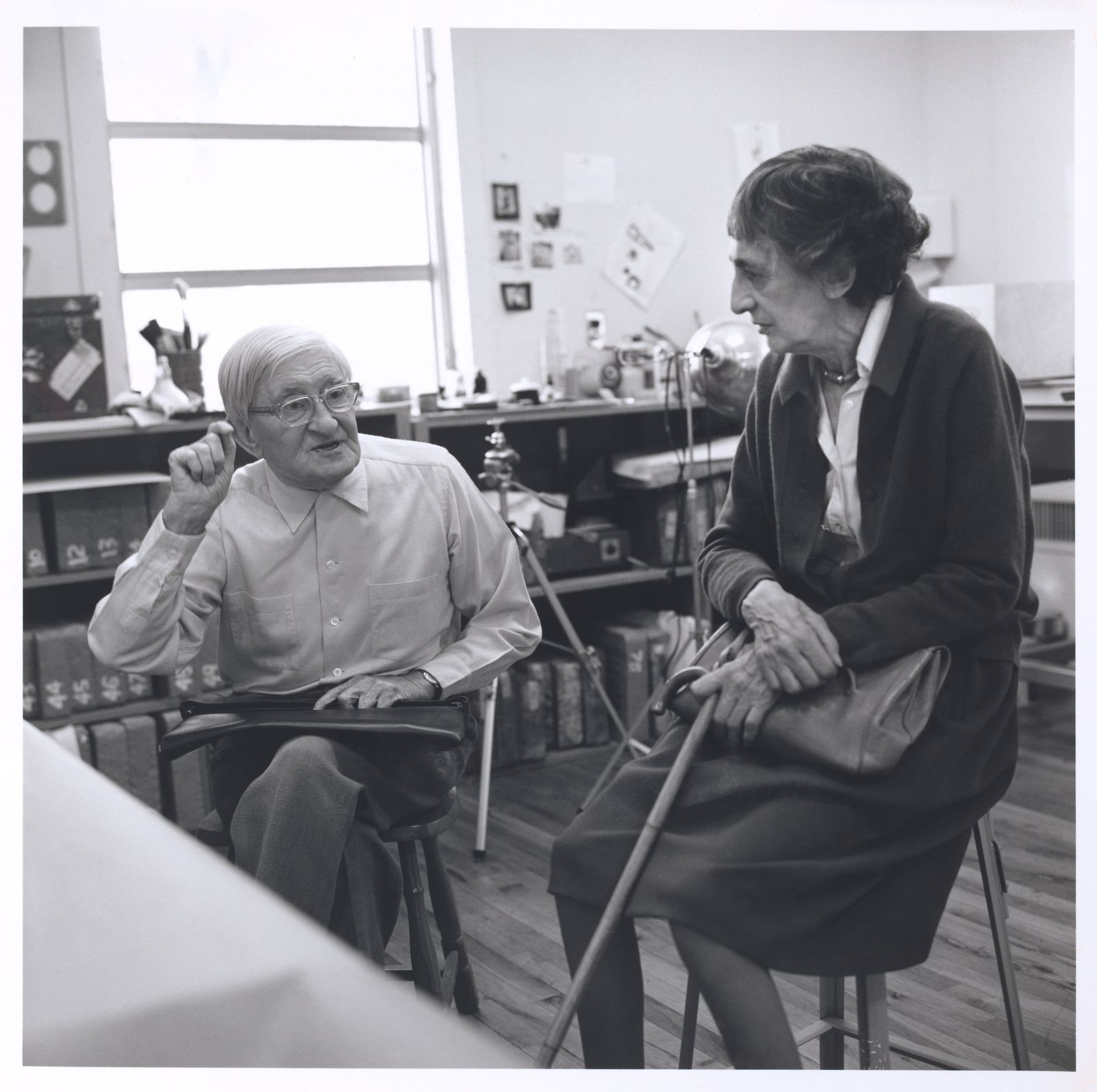
Anni and Josef Albers speak with Kenneth Tyler in the workshop artist’s studio, Tyler Graphics Ltd, Bedford Village, New York, 1976, photograph by Betty Fiske, Kenneth E. Tyler Collection archive, National Gallery of Australia, Kamberri/Canberra © the artist
The weight of the name ‘Albers’ in art and design has been felt for decades and studied in great detail, but Josef’s and Anni’s work has never been approached in an exhibition from this distinct location.
The 2024 National Gallery exhibition and accompanying publication look back to the radical environment of the Bauhaus and illuminate those people and principles that set the Alberses on their path, while simultaneously following the forward momentum of their influence on creative practice.
This is an edited excerpt from Imogen Dixon-Smith’s introduction to Anni and Joseph Albers published by the National Gallery to accompany the exhibition of the same name which ran from 8 June until 22 September 2024.
This story was first published in The Annual 2024.
References
1 Anni Albers, letter to Wassily and Nina Kandinsky, 22 August 1936, published in Nicholas Fox Weber and Jessica Boissel, Josef Albers and Wassily Kandinsky: friends in exile; a decade of correspondence, 1929–1940, translated by Oliver Pretzel, Hudson Hills Press, Manchester & New York, 2010, p 87.
2 Anni Albers, On weaving, Studio Vista, London, 1966, p 38.
3 Kenneth Tyler, letter to Josef Albers, 31 October 1966, typescript, JA 42-7-1, Papers of Josef and Anni Albers, the Josef and Anni Albers Foundation, Bethany, Connecticut.
4 Josef Albers, phone conversation with Kenneth Tyler and Henry Hopkins, c 1966, transcript, box 3, folder 5, Kenneth E. Tyler Collection archive, National Gallery of Australia.
5 Anni Albers, 1966, p 39.